


Article: We, the People, Reimagined
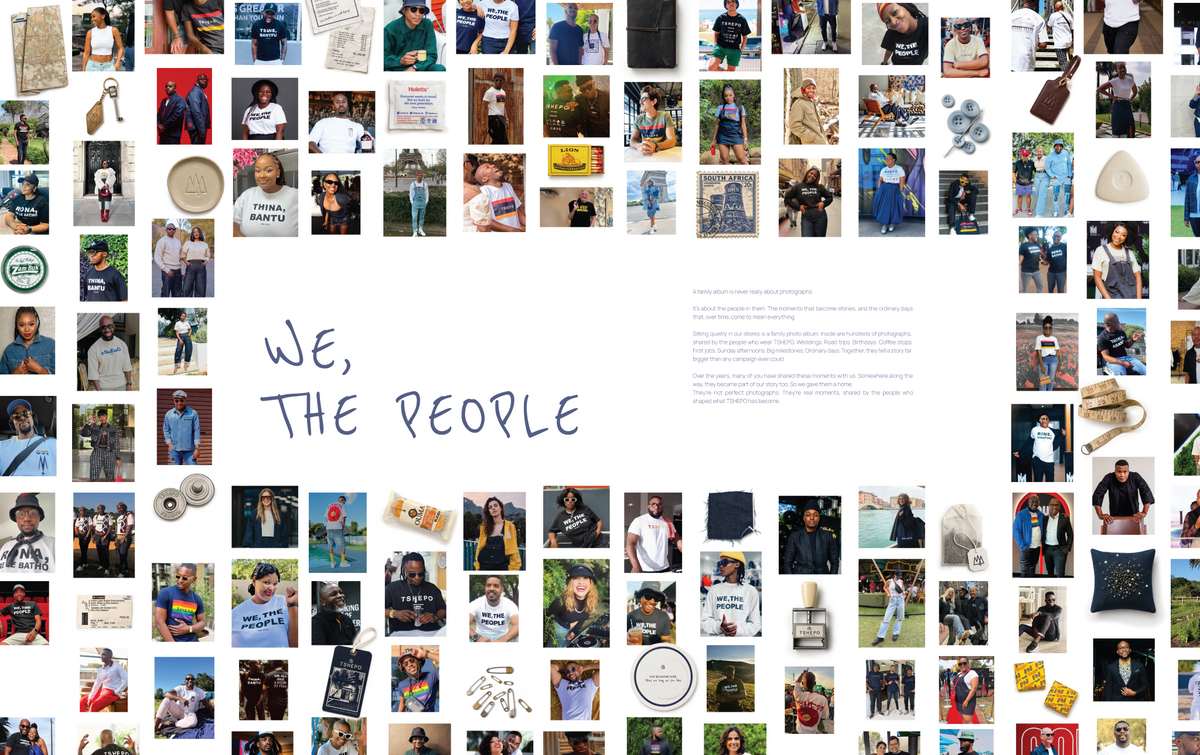
We, the People, Reimagined
The past gave us a language. The present asks what we will do with it.
We, the People: What We Carry Forward

Whether your story begins at a sho’t left, along a tree-lined avenue, or as ngwana wa ko next door, where we come from has a way of staying with us.
It lives in our language, our names, the places that raised us and the people who taught us how to move through the world. It lives in the things we inherit without ever being formally handed them: resilience, humour, faith, defiance, possibility. The older we get, the more we understand that heritage is not only found in monuments, archives or the stories of extraordinary people. It is also carried quietly through ordinary lives.
At TSHEPO, that has always brought us back to one place.
The people.
For Heritage Month, we have been thinking about the story of We, the People, and how three words first encountered at Constitution Hill grew into a language that TSHEPO has continued returning to over the years.
It began with South Africa. It began with belonging. But somewhere along the way, it also became a question about what we choose to do with everything that has been handed to us.
We, the People
In 2019, Tshepo Mohlala was at Constitution Hill when lawyer and writer Lwando Xaso read the opening words of the South African Constitution:
“We, the people of South Africa.”
Simple words, carrying an enormous inheritance.
They speak to a country built not only through institutions and political systems, but through people. Through those who resisted, organised, imagined and sacrificed. Through those whose names appear in history books and the many more whose names never will.
There was something in those words that felt familiar to TSHEPO.
The brand had always been deeply local, long before localisation became a fashionable way of talking about brands. Johannesburg was not a backdrop to escape from on the way to somewhere more important. It was our canvas. Tsakane was not something to edit out of the founder story. It was part of the reason the story mattered.
TSHEPO grew from the belief that an African name could carry ambition without apology, and that a person should never have to distance themselves from where they come from in order to imagine where they might go.
In 2020, during the isolation and uncertainty of the pandemic, that belief became the first We, the People T-shirt, created with Woolworths and Constitution Hill.
The timing gave the word we a particular weight.
People had been physically separated from one another, but the moment reminded us just how dependent we remain on community. South Africa had learnt that lesson many times before. Our history is filled with people whose courage became more powerful because it was collective.
The T-shirt sold out, but the idea did not disappear with it.
It expanded into dungarees, further T-shirts and tote bags. In one of the collection’s most powerful details, a steel offcut from the bars of the former prison at Constitution Hill was placed inside the transparent bib pocket of the dungarees.
The material had once belonged to a structure designed to confine people. Now it sat beside language from a Constitution intended to protect their freedom.
Past and present, held in the same garment.
That is the complexity of heritage. We inherit the things that make us proud, but also the things that hurt. We inherit victories, injustices, traditions, contradictions and unfinished work. The responsibility of the present is not to pretend all of it deserves celebration. It is to know the difference between what should be protected, what should be remembered and what must never be repeated.
By 2024, We, the People appeared again in South Africa’s twelve official languages.
The statement did not become weaker because the words changed. It became larger.
There was something distinctly South African in that idea: many languages, histories and cultures standing alongside one another without any one of them having to disappear for the collective to exist.
Because we has never meant same.
It means together.
From Belonging to Action
But belonging cannot be where the story ends.
With words by Lwando Xaso, All Rise! asked what happens after we recognise ourselves as part of the collective.
The phrase comes from the courtroom. When the instruction is given, everyone stands.
That all matters.
Freedom, equality and dignity cannot remain ideas we admire from a distance. The Constitution can name them, but people have to practise them. Rights survive because people defend them. Communities change because people participate in them. Progress depends on somebody deciding that what exists today does not have to be the limit of tomorrow.
All Rise! was therefore never simply an optimistic message. It was a challenge.
If we believe in change, then what are we prepared to change?
If we speak about equality, where are we still allowing inequality to survive?
If we celebrate the courage of those who came before us, what does courage require from us now?
The visual language of that campaign reached back into another part of Johannesburg’s history: Sophiatown and the forced removals of 1955.
Written across walls during that period were the words:
WE WON’T MOVE.

Sophiatown was more than a physical neighbourhood. It had become a cultural world of musicians, writers, families, thinkers and communities whose lives gave the place its character. Apartheid attempted to dismantle that world through forced removal.
The words on those walls were a refusal to be erased.
The residents were ultimately removed, which is why remembering the phrase requires honesty. We should never turn struggle into an aesthetic or pretend that resistance always ends in victory.
But the dignity inside those words still matters.
Sometimes what we inherit from previous generations is not an answer. Sometimes it is the courage to say no.
No to being made smaller.
No to having your worth decided for you.
No to the idea that somebody else gets to determine whether your home, your language, your culture or your ambition deserves space.
Out of resilience, out of courage and for change, generations before us fought their fight.
Ours will not necessarily look the same.
But that does not mean the work is over.
The Right to Dream

Resistance can protect what already exists. Eventually, though, a people also need permission to imagine what does not.
That is where We, the Dreamers enters the story.
If We, the People asked who belongs, and All Rise! asked us to participate, dreaming turned our attention towards possibility.
AW26’s DREAM collection carried that idea through the colours of the TSHEPO flag: red for African soil, sacrifice and the courage it takes to begin; blue for water, indigo and the denim at the heart of the brand; yellow for the rising sun and the promise of what may still come.
Those colours look backwards and forwards at once.
And perhaps that is what a rooted dream should do.
There is an old assumption that success requires leaving something behind: the township, the accent, the African name, the cultural reference that outsiders might not immediately understand.
TSHEPO has always been more interested in the opposite possibility.
What if we carried those things with us?
What if going further did not require becoming less recognisable to ourselves?
The story of TSHEPO itself began with that kind of imagination. Before the stores, collections and recognition, there first had to be someone capable of seeing a future that had not yet provided much evidence for itself.
A Black boy from Tsakane had to imagine his name above a fashion house before anybody could walk through its doors.
That kind of dreaming can look unreasonable from the outside.
But dreams become dangerous in the best possible way when they stop being private. When somebody sees what you built and their own sense of possibility becomes larger because of it, the dream has already begun to travel.
It becomes bigger than the dreamer.
It becomes for my people.
For My People


There is something intimate about those words.
My people.
Not ownership, but connection. Not a market segment, but a relationship.
Who are your people?
Who are you making room for?
Who should be able to walk further because you chose to begin?
For TSHEPO, the answer has never only been the person purchasing the garment.
The people are the hands inside the Atelier. The team standing on the shop floor. The communities around Victoria Yards. The collaborators, photographers, makers and friends who have shaped different chapters of the brand. The people who wear TSHEPO into their own lives and eventually make the clothes part of stories we may never even hear.
They are also the people who look at what has been built and recognise something of themselves in it.
That might be one of the most powerful forms of inheritance.
One generation fights to make something possible. The next grows up believing it is normal.
A name that once had to prove it belonged on a store becomes a name another child sees without questioning whether it belongs there at all.
Our genes make us family.
And at TSHEPO, denim has always given us another way of telling that story.
Jeans are made to age. They soften, fade and take the shape of the person wearing them. Time does not erase their character; it adds to it.
The older they get, the more particular they become.
Maybe people are not so different.
We carry traces of those who came before us, but we are not copies of them. Every generation adds something. Every life leaves its own marks.
We, the people, tell the denim story.
Until Africa Is United
And if we allow the definition of our people to keep expanding, eventually the question travels beyond neighbourhood and nation.
Until Africa Is United.
The power of that statement sits partly in the word until.
It acknowledges that the work is unfinished.
Africa has never been one language, one culture or one way of seeing the world. Its plurality is precisely what makes simplistic ideas of “African identity” impossible.
Unity should not ask us to erase those differences.
It should ask whether we can recognise ourselves in one another without demanding sameness first.
The borders, politics and histories that separate us are real. So too are the histories of movement, trade, exchange, culture and kinship that existed long before many of those borders did.
Until Africa Is United is not a declaration that we have arrived.
It is a direction.
And perhaps every generation needs one.
To Us, the People

To the Mandelas, the Slovos, the Sisulus, the Sobukwes, the Mbekis and the Meers whose names entered history.
And to the countless names that did not.
To the mothers, fathers, neighbours, teachers, makers and ordinary people whose choices quietly changed the lives that followed them.
To us, the people of South Africa.
And to you. Yes, you.
Heritage Month is not only an invitation to admire what previous generations left behind. It is a reminder that we are standing inside the history somebody else once called the future.
What we do here matters.
The way we treat one another matters.
The things we make, protect, teach, question and dream about matter.
We inherit resilience, but we must decide what to do with it. We inherit freedom, but we must decide how widely we are willing to share it. We inherit stories, but every generation must decide what its own chapter will say.
So know where you come from.
Carry it proudly.
Let it give you roots, but never let it tell you how high you are allowed to grow.
And when the world asks who gave you permission to take up that space, remember that some answers are older than any one of us.
We, the people.


Leave a comment
This site is protected by hCaptcha and the hCaptcha Privacy Policy and Terms of Service apply.