
Skip to content
TSHEPO — Navigation

ABOUT US

Tshepo means hope. It was our founder’s name long before it was stitched into a label or placed above a store. It was given to a boy raised in Johannesburg by three women who taught him that hope is not something you wait for. It is something you practise.

His grandmother, Magriza, taught him through stories. As a pastor, she understood how a story could guide a person, keep a memory alive and bring a community together. His mother, Masesi, showed him the kind of resilience that is rarely announced but always felt, while his aunt, Takalani, introduced him to fashion and denim, opening his eyes to the way clothing could change how a person carried themselves.

Together, they gave Tshepo his first understanding of care, dignity and self-worth. They also taught him that what we inherit is not only what is left behind for us. It is what we choose to carry forward.

Tshepo began his studies in filmmaking because he wanted to tell stories about people, place and identity. He later moved into fashion design, where storytelling found a more tactile form and he learnt the craft required to turn an idea into a garment.

In 2015, he made his first pair of jeans and discovered that a story did not have to be projected onto a screen to move through the world. It could be worn.

That first pair did not arrive with certainty about everything that would follow. It carried something more useful: the belief that South African craftsmanship deserved to be seen, valued and given its place on the global stage.

TSHEPO began there, with a name, a pair of jeans and the decision to believe in what they might become.

READ MORE: TSHEPO THE JEANMAKER

HOME COMES WITH US

That first pair began the brand, but Victoria Yards gave it a home.

In 2018, TSHEPO moved into Victoria Yards, and Johannesburg became more than the city in which the brand had been founded. It became part of the way the brand worked.

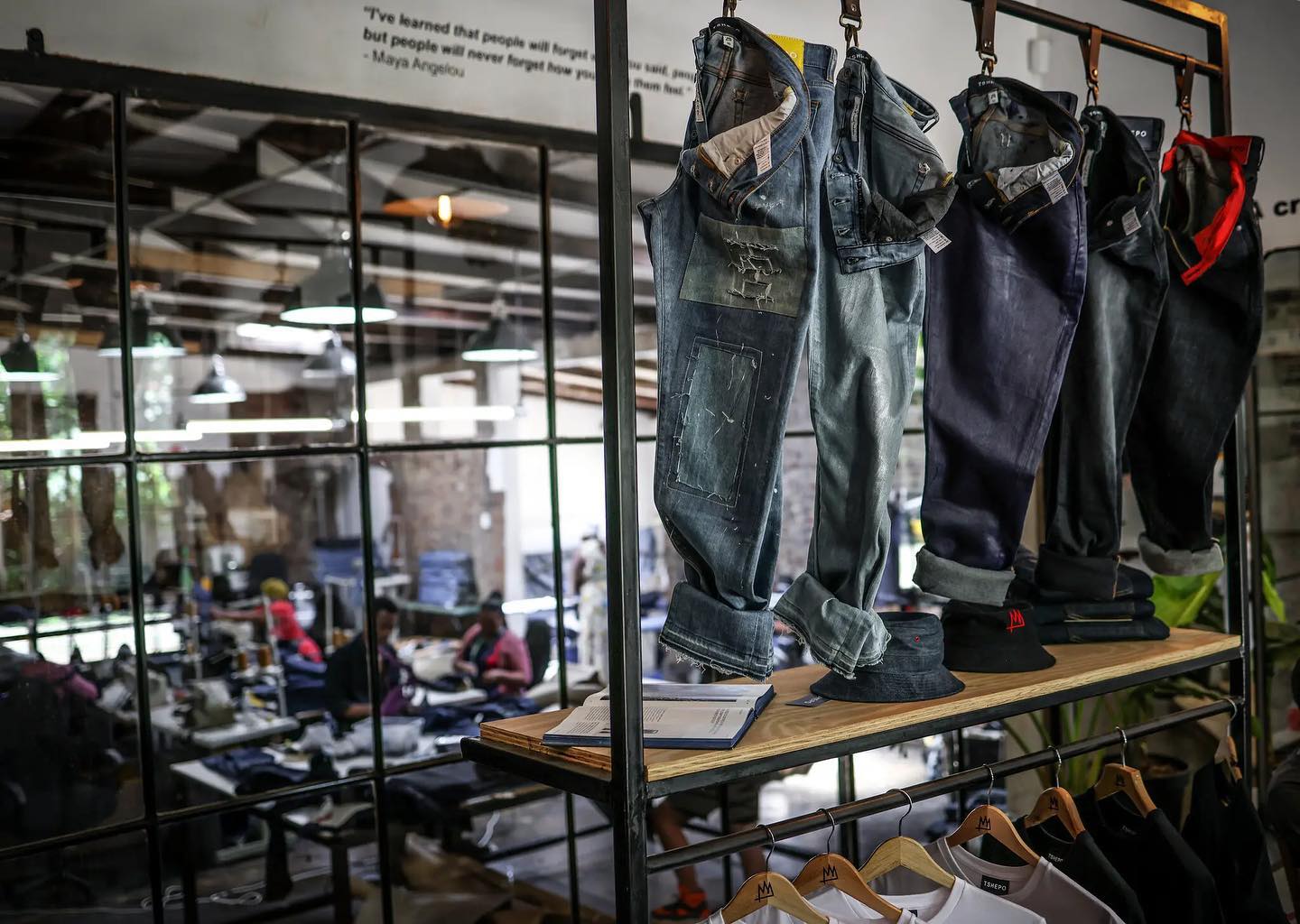
Victoria Yards is a place where making is visible. Artists, gardeners, craftspeople and neighbours share the same courtyards, conversations and daily rhythms. The buildings carry their materials honestly, and the work taking place inside them is never entirely separate from the community beyond their doors.

It became the home of the TSHEPO Atelier, where ideas could be tested, skills developed and the early ambitions of the brand turned into a daily practice.

As the brand began to grow, Tshepo looked to the streets surrounding Victoria Yards and met people in Bertrams who already knew how to sew. Many of those who joined the team lived nearby, and some still walk between the Atelier and home today.

That closeness matters because it keeps the work connected to the lives of the people doing it. By the end of the day, parents can return to their families without losing hours to the journey home. Knowledge can be built within a community, while opportunity remains close enough to change the everyday reality of the people it is meant to serve.

This is where hope becomes practical. It becomes a skill passed from one pair of hands to another, a pattern refined until the fit is right and a garment pressed with care before it leaves the Atelier. It becomes the opportunity to do meaningful work without having to leave your neighbourhood behind.

The garments may carry Tshepo’s name, but the story belongs to everyone who has helped build them.

READ MORE: FROM THE TSHEPO ATELIER

LEARN MORE: WHY CRAFT STILL TAKES TIME

A LANGUAGE OF OUR OWN

What Tshepo found in denim was a material that seemed to understand people.

Denim does not remain as it was on the day it was made. It listens to the body, responds to movement and gathers the evidence of a life being lived. It fades where it is touched, softens where it is folded and becomes more personal with time. The maker begins the garment, but the wearer continues it.

This is why denim has never felt like an ordinary category to us. It gave TSHEPO a language through which to speak about identity without prescribing it. Every piece leaves space for the wearer to bring something of themselves.

Our work with Japanese selvedge denim deepens that relationship. Selvedge asks for patience from the people who make it and from the person who eventually wears it. Its character is not revealed all at once; it emerges slowly as the fabric settles into a life. We value it because it reflects the kind of work we believe in: considered, enduring and made with as much care on the inside as on the outside.

Although TSHEPO has grown beyond denim into a wider wardrobe, the lessons of the fabric remain present in everything we make. We continue to think about how clothing moves, how it ages and whether it has been made well enough to become part of someone’s life.

Denim was our beginning, but more importantly, it taught us how we wanted to continue.

READ MORE: THE FABRIC REMEMBERS

LEARN MORE: THE FUTURE OF DENIM

WHAT WE CARRY

Some parts of the TSHEPO story are held in words. Others are carried through symbols.

The three prongs of the Crown honour Magriza, Masesi and Takalani, while the needle and thread at its centre represent the work through which their influence continues. The Crown is not something worn for status. It is an inheritance entrusted to us, and a reminder that knowing your worth also means remembering the people who helped you recognise it.

Beside it sits the TSHEPO flag, whose story came to us through the Bapedi people and the richness of their culture. Its red carries the African soil from which we come, its blue holds our love of denim and its gold looks towards prosperity and the future we are building together.

The flag appears on every TSHEPO garment. Sometimes it is immediately visible, while at other times it waits within a quieter detail. Wherever it appears, it signals belonging.

Where the Crown keeps our inheritance close, the flag reminds us that the story is larger than any one person. Together, they hold the tension that has shaped TSHEPO from the beginning: knowing who you are while remaining connected to something beyond yourself.

READ MORE: THE STORY BEHIND THE CROWN

READ MORE: THE STORY OF THE FLAG

HOW FAR HOPE CAN TRAVEL

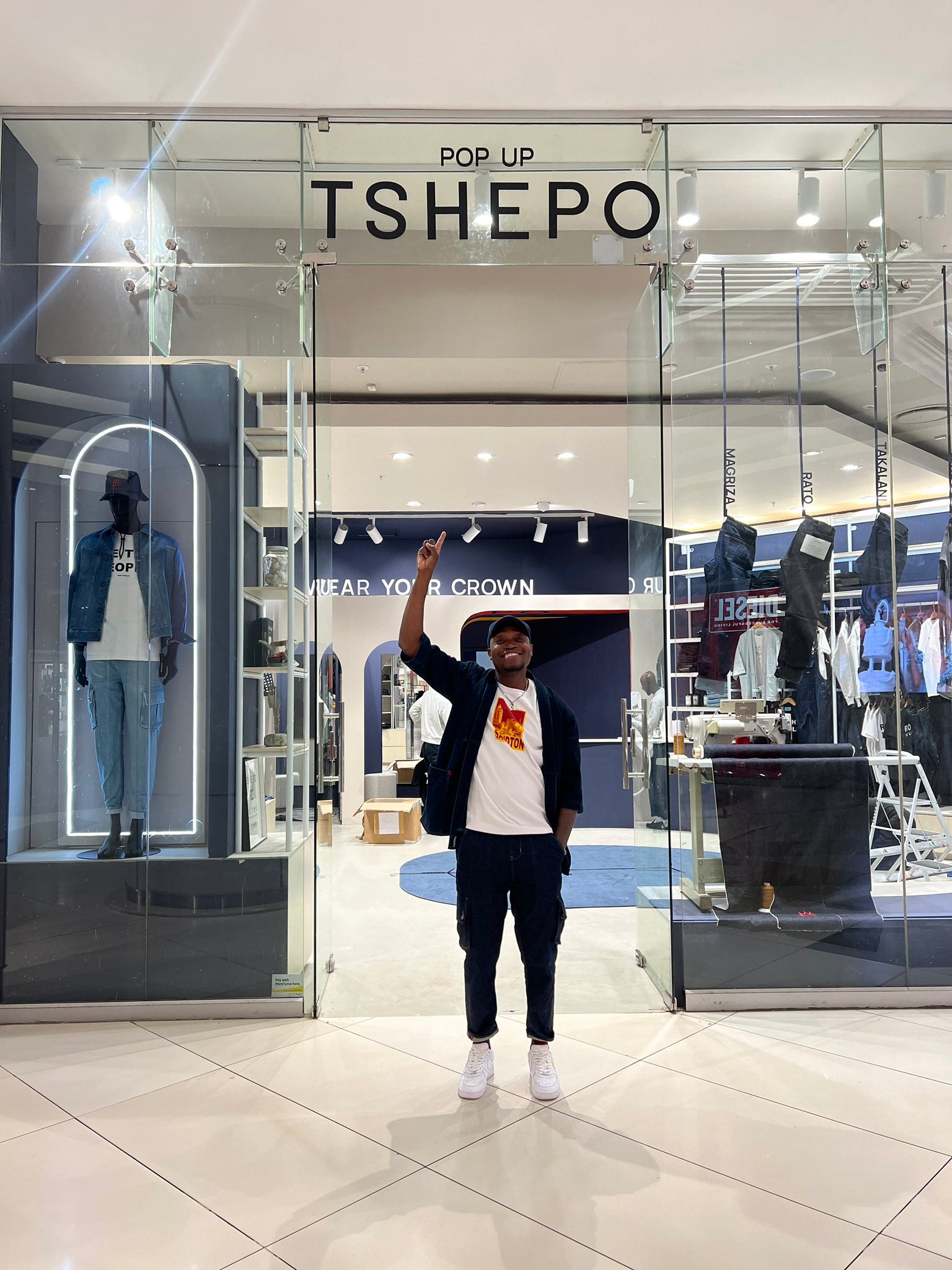
From Victoria Yards, the TSHEPO story began finding new homes at Hyde Park Corner, Sandton City and Mall of Africa. In 2026, it travelled beyond Johannesburg for the first time with the opening of our store at the V&A Waterfront in Cape Town.

Each new space has allowed more people to enter the story, but none represents a departure from where we began. At TSHEPO, home has never been something we leave behind. It is something we carry with us.

The warmth of Victoria Yards travels through the materials we choose, the care with which each store is considered and the way people are welcomed when they come through the door. The address may change, but the intention remains the same: to create a place where people feel recognised, where clothing can be understood rather than hurried past and where conversation is as much a part of the experience as the garment itself.

Our ambition reaches far beyond the places in which TSHEPO lives today. We want to see a South African fashion house stand confidently on the global stage, carrying Johannesburg with it and speaking in a language that does not need to become less African in order to be understood.

For us, hope has never meant pretending that the road will be easy. It means deciding that the road is still worth taking. It means trusting that care matters, that craftsmanship has a future and that something made with honesty in one corner of Johannesburg can find meaning in the life of someone anywhere in the world.

A single pair of jeans has become a growing house, but the belief inside it has remained remarkably close to the beginning. We are still making room for people to recognise their worth, carry their stories with pride and feel at home in what they wear.

Tshepo means hope. It was our name before the world knew it, and it remains the reason we keep building.

READ MORE: MALL OF AFRICA, OUR NEWEST HOME

READ MORE: THE LONG ROAD TO LEGACY